Navigating the ESX trading platform Neway: How you can track your favorite listed companies stock and Invest
Ethiopia’s first organized securities exchange, Ethiopian Securities Exchange (ESX), was officially launched in January of 2025. Licensed and regulated by the Ethiopian Capital Market Authority, ESX is playing the central market organizer role for the country’s nascent stock market. Since its official launch, the ESX has overseen the listing and share registration of major private banks in Ethiopia, including the state-owned enterprise Ethio Telecom.
In August of 2024, the Ethiopian Securities Exchange signed a technology agreement with a global capital markets technology solutions provider, Infotech Private Limited, for the design, supply, and installation of an electronic trading platform and a broker back office and order management system that was available as a mobile application to the general public in a pilot phase by the name Marlin® ESX, which then developed into the Neway ESX app—the official web and mobile trading platform of the Ethiopian Securities Exchange.
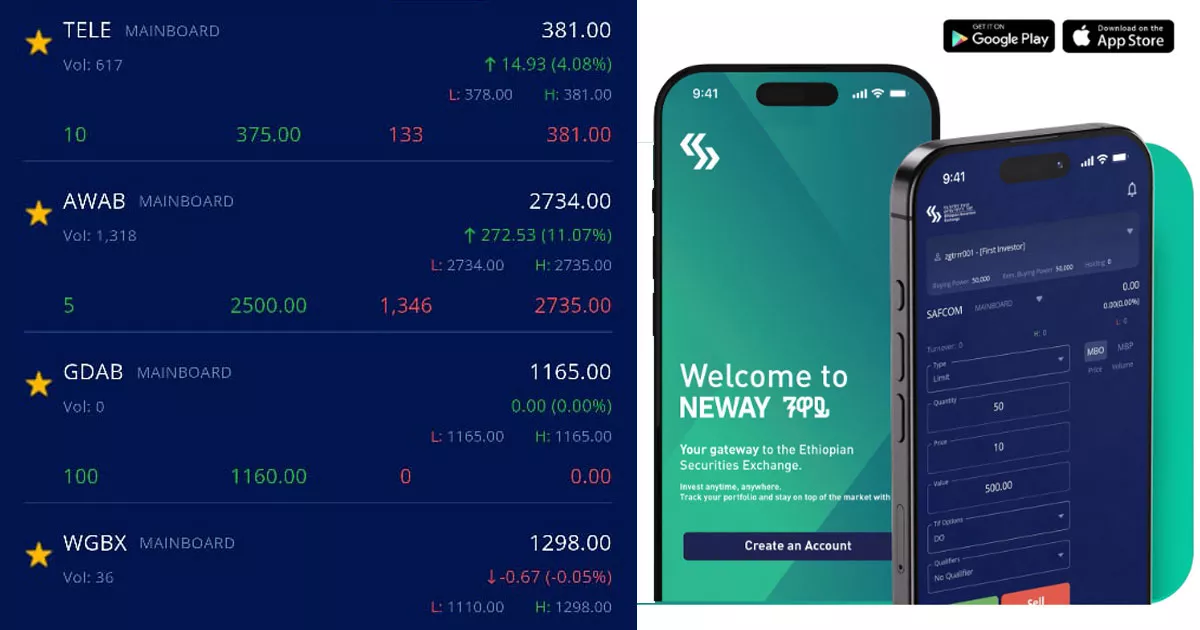
The ESX officially launched ንዋይ/Neway in March 2026, making it available on both Google Play and the App Store, with remote onboarding, access to real-time market data, simulated trading (mock trading) features, portfolio management, and actual trading.
However, the Neway ESX app didn’t come as the perfect trading app out of the box. Its initial implementation phase was mired with bugs, security red flags, and bad user experience (UX) issues. Though structured similarly to many professional trading platforms, it’s not as intuitive to navigate for retail/new investors. There are no easily accessible links to tutorials, platform guidance or tooltips (little “i” icons on apps) that you can tap to see definitions and explanations.
We at Capital251 reviewed the Neway app and found the interface to have a steep learning curve for anyone new to financial markets. And we decided to give you a brief explanation of the Neway app dashboard and the data displayed to help you better navigate the app and become a well-versed investor.
First, you need to download the Neway ESX app; you can find quick download links from the official Ethiopian Securities Exchange website. ESX.et
Once downloaded, follow the on-screen registration process to create your account.
Login to your account and you will see a screen similar to the image attached below.
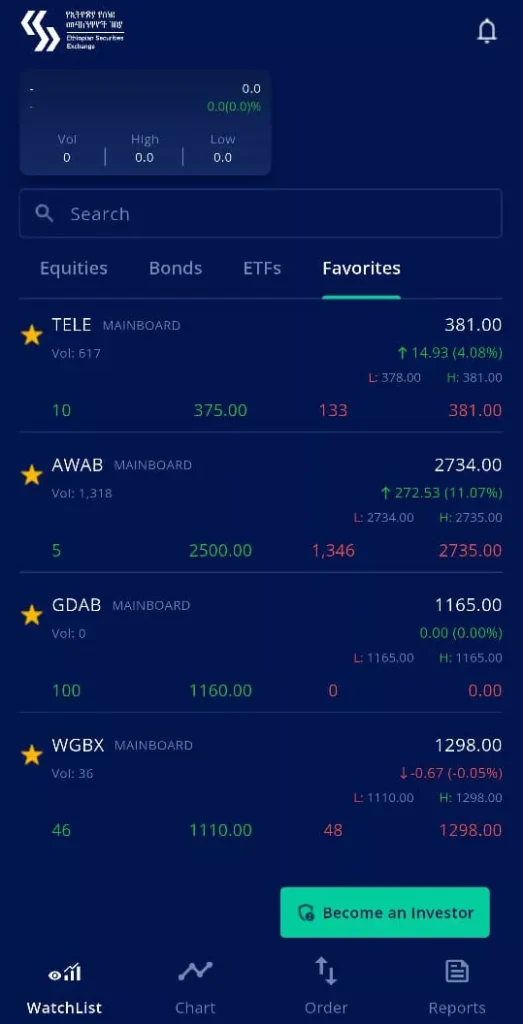
At the bottom, you can see four tabs, ‘WatchList’, ‘Chart’, ‘Order’ and ‘Reports’
WatchList
This is where you can find listed companies stock information, Bonds, ETFs(Exchange Traded Funds) and a ‘Favorites’ section where you can mark a stock as a favorite by clicking the star icon.
Chart
The chart pages show you detailed financial performance data of a stock or bond. By selecting a stock ticker (symbol used to identify a company) from the drop-down at the top, you can find a graphical representation of the stock’s performance, current value, bid and ask prices, volume of the trading session, number of trades, and change in percentage (%) for the equity/share.
Order
The order page is where you buy or sell shares of a company, for which you will need an investor account, that you can open using the ‘Become an Investor’ button displayed on the Watch List page. Since ESX uses a Delivery Versus Payment (DvP) settlement system, you can only buy and sell securities through a brokerage account, which you will need to register with a trading member (broker or investment bank) licensed by the Ethiopian capital market authority. The trading member will need to verify your account information and integrate it with a unique Central Securities Depository (CSD) account created just for you.
Reports
On this page you can track your portfolio (personalized collection of financial assets you own).
Let’s dive into the details of stock data presented by the ESX Neway app. As you can see from the image, there are sections listed side by side at the top: ‘Equities,’ ‘Bonds,’ ‘ETFs,’ and ‘Favorites.’
For now let’s just focus on the ‘Equities’ section, which lists shares of prominent Ethiopian companies, including Wegagen Bank (WGBX), Awash Bank (AWAB), Geda Bank (GDAB), and Ethio Telecom (TELE). You can also invest in bonds and ETFs by visiting the respective section, but as a retail investor, it’s best to focus on the equities (stocks) section while starting out your investment journey.
Right below ‘Equities’ section, you can see ‘Gainers’, ‘Losers’ and ‘Vol Leaders’ section.
The Gainers/Losers section ranks a listed company’s stock by its percentage move since the market closing at the end of yesterday’s trading day.
The volume (Vol.) leaders section ranks stocks by the total number of shares traded. It shows you aggregate data from the whole trading day.
Let’s take a look at one particular individual stock, Awash Bank, which is represented by a ticker symbol, AWAB.
You can see a star symbol before the AWAB stock symbol; this helps you add it to the Favorites section.
The Vol: 1318 is the total number of Awash bank shares traded today.
MainBoard represents the financial strength of the company, listed on the main market of ESX, which requires a capital of 500 million Ethiopian birr and at least 300 public shareholders.
2734.00 is the last traded price of Awash bank stock. It shows the price at which the most recent shares of Awash was actually bought or sold.
↑ 272.53 (11.07%) shows the change in value since the previous closing price.
L: 2734.00 shows the lowest price that Awash Bank(AWAB) shares traded so far today.
H: 2735.00 shows the highest price AWAB shares traded so far today.
The numbers you see just above the separator line,
5 2500.00 1,346 2735.00
Represents the order block, which shows the current pull and push between buyers and sellers.
The number in green is the bid price, meaning there is a buyer (buyers) looking to purchase 5 shares of AWAB at 2,500 ETB. The bid price is generally the highest price a buyer is willing to pay.
The number in red is the ask price, meaning there is a seller (sellers) offering to sell 1,346 shares of Awash bank at the price of 2,735.00. The ask price is generally the lowest price a seller is willing to accept.
The difference between the Ask and Bid price is known as a ‘Spread’. When the gap is small it indicates the stock is more liquid and easier to buy or sell.
The Ethiopian Securities Exchange uses an order matching system that prioritizes orders based on who is offering the most favorable deal to the other side. If you are a buyer, logically you want to buy as cheap as possible, but if you are a seller, obviously you want to sell to the person willing to pay the most. So, the exchange system automatically filters all the buy orders and shows you the highest price currently offered if you are a buyer and the lowest price currently being requested if you are a seller.
Finally, you will need to understand the price-time priority principle, where better prices gets matched first. If two investors bid the exact same price, the person who placed their order first gets priority.