Abay Bank Shares 2026 | Prospectus PDF Download
On May 11, 2026, Abay Bank registered 9,657,286 existing Ordinary Shares (par value ETB 1,000) with a primary goal of listing on the Main Board of the Ethiopian Securities Exchange (ESX). As required by the Ethiopian capital market authority the bank released a 198 pages prospectus documents on it’s official website investor relations section. The document is available for download here.
Financial Health and Performance (FY 2025)
Revenue Growth: The bank demonstrated strong growth, with interest income rising 35.9% year-over-year to ETB 8,786 million. Fees and commissions also surged by 63.3% to ETB 2,038 million.
Balance Sheet Strength: As of June 30, 2025, the bank held ETB 71,915 million in total deposits and ETB 49,217 million in loans and advances.
Capital Adequacy: The Capital Adequacy Ratio (CAR) stands at 13.5%, which is above the regulatory minimum of 11.0%, though the buffer has narrowed compared to previous years.
Digital Transformation: A significant milestone was achieved with 69.0% of all transactions conducted via digital channels, up from 54.0% the previous year.
Risk Factors for Abay Bank Share
Regional Concentration: A major structural risk is the bank’s heavy concentration in four key districts (Bahir Dar, North East, Dessie, and South West), which account for 65% of all deposits. Persistent regional unrest in Amhara and Oromia could trigger correlated withdrawals or disrupt loan collections.
Liquidity Risk: Approximately 94.0% of the bank’s deposit base is volatile and short-term, creating a potential mismatch with long-term lending.
Foreign Competition: The ongoing liberalisation of the Ethiopian banking sector allows for the entry of foreign banks, which may pressure margins and increase competition for both talent and market share.
Hard Currency Obligations: The bank has fixed hard-currency contracts, such as a USD 2.97 million agreement with Oracle, making it vulnerable to foreign exchange volatility and mobilization bottlenecks.
Strategic direction of Abay Bank S.C.
Dual-Banking Model: Abay Bank operates both Conventional Banking and Sharia-compliant Interest-Free Banking (IFB) through its “Abay Sadiiq” product line.
Expansion: The bank maintains a network of 546 branches and intends to leverage digital integration to mitigate the risks of physical branch reliance during regional crises.
Leadership: The bank is led by CEO Yehuala Gessesse Gelaye and CCSO Desalegn Ayalew Worku.
Internal Oversight: Notably, the company does not have a designated Chief Financial Officer (CFO); instead, the finance function is overseen by the Chief Corporate Service Officer (CCSO).
Advisors: The transaction is advised by Deloitte (Transaction Advisor) and Tamrat Assefa Liban Law Office (Legal Advisor).
How to Buy Abay Bank Shares in 2026
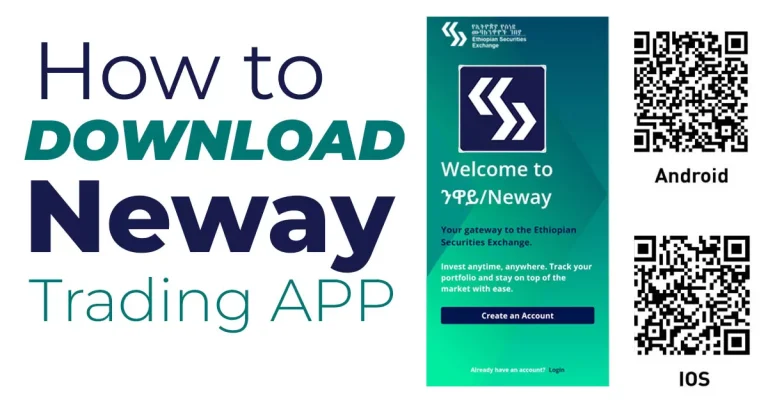
Ethiopian securities exchange has officially launched it’s trading app, Neway Mobile Application. Whether you are in Addis Ababa or anywhere else across the country, you can now trade shares directly from your smartphone. Here’s how you can start trading on ESX using Neway app.
Download and Sign Up: Go to the Google Play Store or Apple App Store and download the Neway app.
Once opened, navigate to the “Create Account” page. Enter your name, email, and phone number, and create a secure password.
Verify Your Identity: You will receive a six-digit OTP (One-Time Password) via your email to verify your identity. Enter this code into the app to activate your trading account.
Explore the Market: Once logged in, you can browse various investment options, such as shares from Gada Bank, Wegagen Bank, and even government Treasury bills (T-bills).
While you can see the listings, you cannot trade yet without a brokerage account. Here is how to set it up:
Upload Documents: Finally, upload a digital copy of your National ID, Passport, or Driver’s License, along with your signature and a photo.
Select a Broker: Inside the Neway app, click the “Become an Investor” button. You will see a list of approximately six officially licensed brokers. Choose one to proceed.
Provide Personal Information: After agreeing to their terms and conditions, you must fill out your profile. This includes your full name, TIN number, Fayda (National ID) number, and residential address.
Link Your Banking: You must link a bank account for your transactions. You can link it directly or pay the broker to manage it for you. You even have the option to use different bank accounts for different types of investments (e.g., one for bank shares and another for T-bills).
Compliance and Risk Assessment: You will be asked “Risk Tolerance” questions to determine your investment style. Additionally, you must disclose any legal or professional ties, such as being a public official, having a political affiliation, or working within capital market service providers like investment banks.
Even after submitting your documents, you cannot trade instantly. Your chosen broker must first verify your information and open a CSD (Central Securities Depository) account for you. This is a secure digital treasury where all your shares and bonds are officially registered.
Once the broker notifies you that your account is ready, you can return to the Neway app. From there, you will be able to:
- View your current share holdings.
- Track your transaction history.
- Monitor profits, losses, and your withdrawable balance.
- Start buying and selling shares freely!
Please note that, ESX explicitly cautioned that during the initial phase of implementation, access to the NEWAY platform is limited to the territory of Ethiopia.
And if you have questions or need assistance using NEWAY, the ESX mobile trading platform, you can Call Center: 9920, Hours: Monday – Friday | 8:30 AM – 5:30 PM, Email: [email protected] (anytime).
Abay Bank stock is “worth buying”
Abay Bank has demonstrated significant momentum as a mid-tier lender aggressively moving into the upper tier of private banks:
Exceptional Earnings Growth: For FY 2024/25, the bank reported a net profit of approximately ETB 3 billion, nearly doubling its previous year’s performance. Gross profit surged by 116% to ETB 4.2 billion.
Earnings Per Share (EPS): The EPS reached ETB 463 per ETB 1,000 par value, a 65% year-on-year increase. This represents a return of 46% on par value, making it highly attractive for investors seeking yield.
Efficiency Ratios: The Return on Equity (ROE) of ~27.9% and Return on Assets (ROA) of 3.8% are both well above the industry average, signaling that management is extracting high value from its capital and asset base.
Digital Transformation: With 69% of transactions now occurring via digital channels, the bank is successfully lowering the marginal cost of service and reducing its long-term reliance on physical infrastructure.
Capital Buffer: The bank’s paid-up capital reached ETB 7 billion by June 2025 and rose to ETB 9.7 billion by December 2025. This puts the bank significantly ahead of the National Bank of Ethiopia’s (NBE) ETB 5 billion requirement (due by December 2026), reducing the risk of forced capital raises that could dilute existing shareholders.
Liquidity: A liquidity ratio of 30.4% and a conservative loan-to-deposit ratio (compared to peers running at 80%+) provide a safety net against sudden shocks or withdrawal spikes.
Professional investors must “normalize” the earnings and look at structural vulnerabilities:
- The Forex “Distortion”: A substantial portion of the 2024/25 profit surge (approx. 44% of PBT) was driven by net forex valuation gains (ETB 1.87 billion) following the Birr’s liberalization. If you strip away these one-off currency gains, the “core” banking profit is still healthy but significantly less dramatic. Future earnings may not repeat this windfall.
- Regional Concentration: 65% of all deposits are concentrated in four districts (Bahir Dar, North East, Dessie, and South West). Persistent regional instability in these areas represents a concentrated risk factor that could disrupt loan collections or trigger mass withdrawals.
- Upcoming Competition: The liberalization of the Ethiopian banking sector to foreign banks will likely compress margins. Mid-tier banks like Abay may face the most pressure on their corporate and trade-finance portfolios as larger international players enter the market.
The bank is listing on the Ethiopian Securities Exchange (ESX) via “Listing by Introduction.”
- Implication: This means no new shares are being issued at the start, and no new capital is being raised. The primary benefit is liquidity for current shareholders and price discovery.
- Valuation Note: While the par value is ETB 1,000, the market price on the ESX may trade at a significant premium given the high ROE and EPS growth.
Final Assessment
- For Value/Yield Investors: The strong EPS growth and early compliance with capital requirements make it a solid contender in the Ethiopian banking space.
- For Risk-Averse Investors: The heavy regional concentration and the reliance on volatile forex gains for the recent profit peak suggest a need for caution.
A sophisticated approach would involve comparing its Price-to-Earnings (P/E) ratio (once trading begins) against larger peers like Awash or Abyssinia to see if the “mid-tier growth premium” is justified.